Artificial Intelligence (AI) has rapidly become a core part of modern businesses, especially after the global adoption of tools like ChatGPT. Initially, AI systems were limited to simple question-answer interactions. Today, the focus has shifted toward AI agents — intelligent systems capable of performing tasks autonomously, much like human workers.
According to industry insights, over 60% of businesses expect AI to significantly improve productivity, while many organizations are adopting AI due to workforce limitations. AI agents are already making a strong impact across industries such as healthcare (drug discovery), finance (fraud detection), and e-commerce (supply chain optimization).
If you want to stay competitive, improve customer engagement, and scale your operations efficiently, building an AI agent is no longer optional — it’s strategic.Let’s explore how AI agents work, why they matter, and how you can build your own AI agent to stay ahead in this evolving digital landscape.
What Is an AI Agent?
An AI agent is a computer program designed to operate autonomously to achieve specific goals defined by the user. It can perceive its environment, collect relevant data, and make informed decisions to accomplish predefined objectives with minimal human intervention.
Beyond context awareness, AI agents can continuously learn and improve by interacting with data, their environment, and human feedback, allowing them to become more efficient and effective over time.
Types of AI Agents
AI agents can be categorized based on how complex their decision-making process is.
- Simple Reflex Agents:These are basic agents that act solely on predefined rules and immediate inputs, without considering past experiences or future consequences.
Example: A thermostat that adjusts the temperature based on current room conditions.
- Model-Based Reflex Agents:They maintain an internal model of the environment and make decisions based on that model rather than reacting blindly.
- Goal-Based Agents:These agents work toward specific objectives and plan actions accordingly.
Example: An AI travel planner.
- Utility-Based Agents:They evaluate multiple options and choose the one that delivers the highest value or utility.
Example: Product recommendation systems.
- Learning Agents:These agents improve their performance over time by learning from data and feedback.
Example: Spam detection systems.
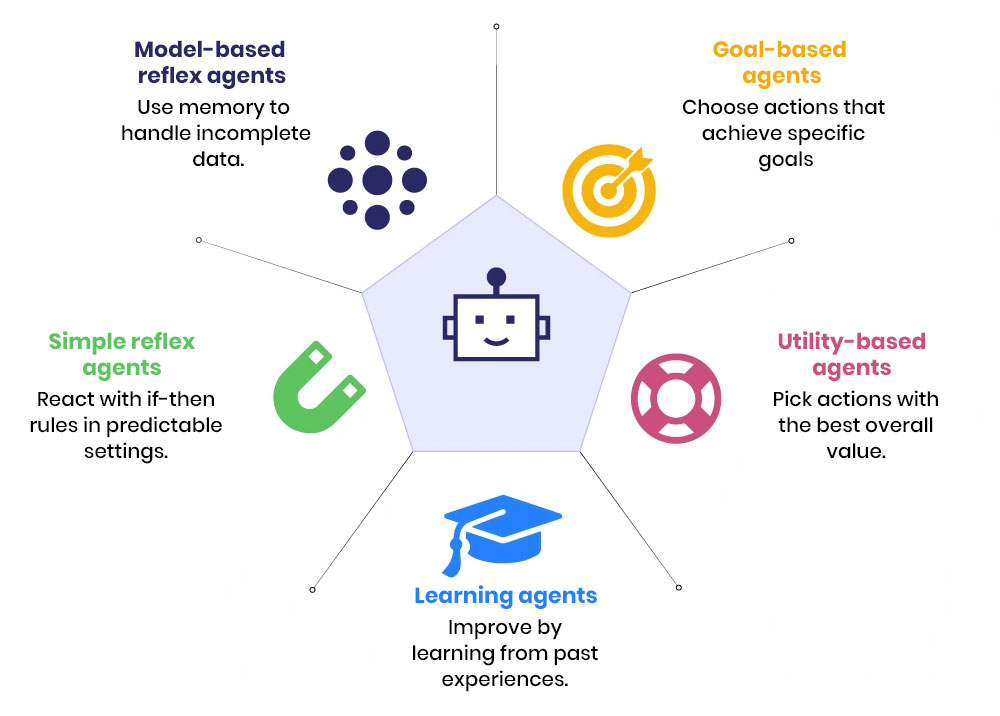
AI Agent Architecture Types
- Hierarchical Agents: These agents operate using multiple layers, where each level is responsible for a specific task. For example, in an e-commerce system, a Level 1 agent may analyze user preferences, while a Level 2 agent uses that information to generate personalized product recommendations.
- Multi-Agent Systems: Instead of relying on a single agent, these systems use multiple agents working together to complete a task. This approach is especially effective for complex problems or improving response speed. For example, one agent may handle web searches, while another accesses and processes information from a knowledge base.
How AI Agents Work?
To build an effective AI agent, it’s important to understand how it functions.
Perception: The first step for an AI agent is to gather data from available sources, such as sensors (cameras or microphones), user inputs (text or voice commands), and databases. For example, the bot receives a user query asking how many people performed a specific action — in this case, how many purchased running shoes along with sports socks.
Decision-Making: After collecting the data, the agent interprets the context of the query and determines the best next step based on its goals, predefined rules, or learned models.In our example, the AI agent uses Natural Language Processing (NLP) to understand the user’s request. It then organizes and classifies the data based on learned patterns and analyzes it using statistical techniques and deep learning models.Looking for a team to build an AI agent? Transform your business with our Generative AI services and hands-on expertise!
Action: Next, the agent executes the chosen action. In this case, it retrieves the relevant sales data from the database, processes it, and uses NLP to generate a clear, user-friendly response.As the AI agent is used and trained over time, it continuously improves. By analyzing past outcomes and incorporating user feedback, it updates its models to deliver increasingly accurate and effective results. This iterative process ensures that the agent becomes smarter and more reliable with continued use.
How to Build an AI Agent: Step-by-Step Process
Define the Purpose and Environment: The first step in building an AI agent is to clearly define its purpose and the environment in which it will operate. This includes identifying the specific task the agent will perform, where it will be deployed—whether on a website, an app, or an internal system—and who will be using it. Having a well-defined purpose ensures that the development process is focused and efficient, avoiding unnecessary complexity.
Build the Right Team: Next, assemble the team needed to develop the agent. Depending on the project’s complexity, this may include machine learning engineers, data scientists, software developers, UI/UX designers, and DevOps engineers. For small businesses, it is also possible to outsource development or start with no-code and low-code AI platforms, which can significantly reduce time and cost.
Collect and Prepare Data: AI agents rely heavily on high-quality data to function effectively. This data can come from internal business records, external datasets, or user-generated content. The key is to ensure the data is clean, relevant, and structured properly, as this directly impacts the agent’s accuracy and performance.
Choose the Technology Stack: Choosing the right technology stack is critical for the agent’s performance and scalability. Common programming languages include Python and JavaScript, while AI techniques may involve machine learning, natural language processing, or computer vision. Cloud platforms like AWS, Azure, or Google Cloud are often used to support deployment and scalability. Decisions made at this stage should account for long-term maintenance and performance.
Design the AI Agent: AI agents rely heavily on high-quality data to function effectively. This data can come from internal business records, external datasets, or user-generated content. The key is to ensure the data is clean, relevant, and structured properly, as this directly impacts the agent’s accuracy and performance.
Collect and Prepare Data: During the design phase, focus on the agent’s architecture, data flow, and user experience. Decide whether the architecture will be modular or concurrent, how data will be received and processed, and how the agent will communicate with users. Incorporating a feedback system at this stage is essential for continuous improvement and learning over time.
Test the AI Agent: Thorough testing is necessary to ensure the agent works reliably and performs as expected. This includes unit testing, integration testing, functional testing, usability testing, and testing for edge cases. Comprehensive testing helps identify issues early and ensures a smooth user experience.
Deploy and Monitor: Finally, after deployment, the agent must be continuously monitored to maintain performance and reliability. Track metrics such as accuracy, response time, and resource usage, and collect user feedback to guide improvements. Regularly updating models and maintaining security, especially when handling sensitive data, ensures the agent remains effective and trustworthy over time.
Why AI Agents Are Important
AI agents significantly reduce manual effort by automating repetitive and time-consuming tasks. Instead of constant human supervision, these agents can operate independently while maintaining accuracy and consistency. This results in:
- Increased productivity
- Faster task execution
- Reduced operational costs
- Better customer experiences
Why It’s Worth Building an AI Agent
While AI agents cannot replace humans in the workplace, they can efficiently handle many routine and repetitive tasks. This allows employees to focus on higher-value work that requires creativity, judgment, and strategic thinking.
But what does this mean for your business? How can building your own AI agent benefit your team, customers, and bottom line? Based on real-world use cases, here are the key signs that an AI agent could add significant value to your organization.
You Want to Improve Operational Efficiency: Many businesses struggle with repetitive processes such as data entry, invoice processing, and document management. These tasks consume valuable employee time that could be better spent on more impactful work. AI agents excel at handling such workloads efficiently and accurately.AI agents can also integrate with multiple internal data sources. For example, in retail, they can analyze sales records and customer relationship data far more quickly and comprehensively than humans, enabling faster and more informed decision-making.
You Want to Improve Operational Efficiency: Many businesses struggle with repetitive processes such as data entry, invoice processing, and document management. These tasks consume valuable employee time that could be better spent on more impactful work. AI agents excel at handling such workloads efficiently and accurately.AI agents can also integrate with multiple internal data sources. For example, in retail, they can analyze sales records and customer relationship data far more quickly and comprehensively than humans, enabling faster and more informed decision-making.
You Want to Save Costs: Automating routine tasks with AI agents can significantly reduce operational expenses. Beyond basic automation, AI agents open up additional cost-saving opportunities depending on how they are implemented. For instance, predictive maintenance allows businesses to monitor equipment using sensor data and identify components that may fail before they cause costly downtime. In finance, AI agents can detect anomalies in transaction data to help prevent fraud. In eCommerce, intelligent inventory management enables businesses to avoid stockouts and plan logistics more effectively. These tasks can be performed at scale by AI agents—something that would otherwise require substantial human effort.Curious about the cost of AI? Explore our blog to learn what factors influence AI pricing and discover expert tips to optimize your investment.
You Want to Turn Data into Actionable Insights: AI agents help businesses unlock the value of their data by identifying hidden patterns and trends. This enables smarter, data-driven decision-making. With real-time analysis and adaptive recommendations, AI agents can continuously optimize processes and respond quickly to changing business conditions.
You Want to Personalize Your Services: AI agents make it possible to deliver highly personalized customer experiences by analyzing user behavior and adjusting in real time. For example, an AI agent can track how visitors interact with your website and tailor content, product recommendations, pricing, or special offers based on individual preferences.AI agents can also manage inventory based on customer demand. If a product is selling quickly in a specific region, the agent can recommend restocking or suggest similar alternatives, ensuring availability and a smooth shopping experience. This level of personalization improves engagement and customer satisfaction.
You Work with Large and Complex Data Sets: If your business handles large volumes of complex data—such as customer purchase histories, website traffic patterns, or supply chain information—AI agents can process and analyze it efficiently. They can identify trends, detect anomalies, and generate insights that would be difficult or time-consuming to uncover manually.In fintech, for example, AI agents analyze spending patterns to detect fraudulent transactions in real time, helping prevent losses before they affect customers. Leading institutions like JPMorgan Chase use AI in similar ways, along with applications such as portfolio management and contract analysis.
The Future of AI Agents
AI agents have the power to transform industries and redefine operational efficiency. By automating routine tasks, optimizing resources, and enabling data-driven decisions, they can save businesses significant time and money. As technology continues to advance, increasingly sophisticated AI agents will emerge, reshaping the way organizations operate and compete.
Ready to leverage the potential of AI agents for your business? At Uptech, we create and implement custom AI solutions tailored to your unique needs. Let’s build an intelligent agent for you—get in touch with our expert team today and explore the possibilities.
AI agents are transforming the way businesses operate by bringing intelligence, automation, and efficiency together. They are no longer optional tools—they are becoming essential digital partners.
By learning how to build your own AI agent today, you prepare your business for a future driven by smart automation. The journey begins with a single agent—but its impact can transform the way you work forever.