MERN is one of the most popular technology stacks today, widely adopted by companies across industries. But is it the right choice for your web application development project? In this article, we’ll explore the MERN stack in detail—its core components, key benefits, and real-world use cases—so you can make an informed decision with confidence.
Choosing the right technologies for web app development has traditionally been a complex and time-consuming process. CTOs and business owners often struggle to evaluate countless tools and frameworks to find the best fit for their needs. However, the rise of prebuilt technology stacks has significantly simplified this challenge, offering streamlined, proven solutions—and MERN stands out as one of the most powerful among them.
What Is the MERN Stack?
The MERN Stack is a JavaScript-based technology stack used for building full-stack web applications.MERN offers a cohesive environment for developing powerful dynamic applications. Plus, the technologies used in this tech stack are open-source and easily accessible. It has become a reliable and efficient choice for web app development. It consists of four core technologies:
MongoDB: It is a document-oriented database that stores and retrieves data in JSON format and is classified as a NoSQL database. With support for horizontal scaling, it makes managing large datasets easy and efficient. Additionally, MongoDB offers rich query capabilities that enable advanced data operations with greater flexibility and performance.
Express.js: Express, also known as Express.js, is a lightweight and flexible web application framework used with Node.js on the backend to build RESTful APIs. It provides a robust set of features that simplify the development of multi-page, single-page, and hybrid web applications.
React.js: A popular JavaScript library widely used for front-end development, React.js enables the creation of dynamic and interactive user interfaces. It delivers faster rendering performance through its built-in Virtual DOM, which efficiently updates only the necessary parts of the UI. React.js also supports reusable components, making it easier to build and maintain complex applications by reusing existing code.
Node.js: As a JavaScript runtime environment, Node.js is widely used on the backend to run applications outside of web browsers. It follows an event-driven, non-blocking I/O model, allowing it to handle operations efficiently. Although it is single-threaded, Node.js can manage a large number of concurrent connections with high performance. Due to these advantages, Node.js remains extremely popular and consistently ranks at the top of lists featuring the most widely used web frameworks.
What Are MERN Stack Development Services?
MERN Stack development services include end-to-end web application development using the MERN technology stack. These services cover everything from ideation and design to deployment and maintenance.
- Custom web application development
- Single Page Application (SPA) development
- RESTful API development
- Enterprise application development
- UI/UX design with React
- Backend development with Node & Express
- MongoDB database architecture
What are the Advantages of MERN Stack Development?
Building a high-quality web application requires a robust and reliable technology stack like MERN. It offers numerous advantages for web app development, including high performance, scalability, flexibility, and ease of development. Below are the key benefits of the MERN stack, explained in detail.
Seamless Development: The MERN stack enables seamless and efficient development by using JavaScript across the entire application, from front-end to back-end. With MongoDB, Express.js, React, and Node.js working together in a unified ecosystem, developers can easily manage data flow, reuse code, and maintain consistency throughout the project. This full-stack JavaScript approach reduces development complexity, accelerates time to market, and simplifies collaboration between teams, making MERN an ideal choice for building modern, scalable web applications.
Open-Source Nature: As a widely adopted open-source technology stack, MERN benefits from a strong and active community that supports problem-solving, knowledge sharing, and continuous improvement. This community-driven ecosystem regularly delivers updates, enhancements, and a wealth of resources that simplify and accelerate the development process.In addition, the open-source nature of the MERN stack eliminates vendor lock-in, enabling flexibility for future changes or technology transitions. It also leads to significant cost savings, as there are no licensing fees involved.
Scalability: As a widely adopted open-source technology stack, MERN benefits from a strong and active community that supports problem-solving, knowledge sharing, and continuous improvement. This community-driven ecosystem regularly delivers updates, enhancements, and a wealth of resources that simplify and accelerate the development process.In addition, the open-source nature of the MERN stack eliminates vendor lock-in, enabling flexibility for future changes or technology transitions. It also leads to significant cost savings, as there are no licensing fees involved.
Code Reusability: Code reusability eliminates the need to reinvent the wheel and allows developers to focus on building new features more efficiently. It also reduces the risk of bugs and inconsistencies across the application. The MERN stack promotes code reusability by using a single programming language—JavaScript—throughout the entire stack. Additionally, React.js further enhances reusability by enabling the creation of modular, reusable UI components, significantly reducing development time and effort.
Flexibility: MERN is a highly flexible technology stack that enables developers to build a wide range of web applications, from lightweight solutions to complex, large-scale platforms. It supports the development of high-performance applications regardless of their size or type. The powerful combination of Node.js, Express, MongoDB, and React.js offers the flexibility to create complex web apps without compromising on performance, while remaining fully customizable to meet the specific requirements of each project.
How Does the MERN Stack Work?
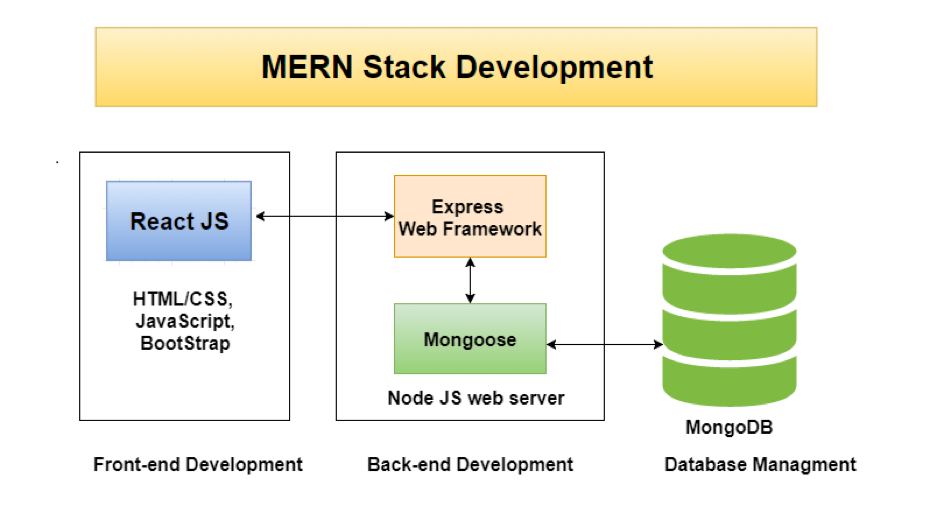
React.js – Frontend Layer: React.js is used to build the frontend of a MERN application. It creates fast, interactive, and dynamic user interfaces using reusable components. When users interact with the application—such as clicking buttons or submitting forms—React efficiently updates only the required parts of the UI and sends requests to the backend APIs for further processing.
Express.js – Backend Application Framework: Express.js acts as the backend framework that manages application logic and routing. It receives requests from the React frontend, processes them based on defined rules, handles authentication and validation, and prepares appropriate responses. Express simplifies server-side development by providing a lightweight and flexible structure.
Node.js – Server Runtime Environment: Node.js runs the backend application and executes JavaScript on the server side. Its non-blocking and event-driven architecture allows the application to handle multiple requests simultaneously with high performance. Node.js ensures smooth communication between the frontend, backend, and database layers.
MongoDB – Database Layer: MongoDB is a NoSQL, document-based database used to store application data. It saves data in JSON-like format, making it easy to work with JavaScript-based applications. MongoDB offers high scalability, flexibility, and performance, which makes it ideal for handling large and complex datasets.
End-to-End Data Flow and Integration: All MERN stack components work together in a seamless flow. User actions on the React frontend trigger API calls to the Express and Node.js backend, which then interact with MongoDB to fetch or update data. The processed data is sent back to the frontend, allowing real-time UI updates and a smooth user experience.
Use Cases of MERN Stack: Types of Web Apps Developed and Examples
MERN stack is used to develop a wide variety of web applications due to its flexibility and open-source nature. The following are some types of web apps built with this tech stack, along with examples.
E-Commerce Applications: Many online learning platforms such as Coursera and Udemy leverage the MERN stack to deliver interactive, user-friendly, and engaging learning experiences.
Blogging Platforms: Platforms like Medium demonstrate how MERN can be used to develop robust blogging systems with advanced content management features and seamless performance.
Project Management Tools: Trello uses the MERN stack to manage projects efficiently, enabling real-time updates, collaboration, and improved productivity.
Social Media Platforms: Social media applications such as Instagram and Facebook utilize MERN-based technologies to manage media content, user interactions, and dynamic page rendering at scale.
Real-Time Chat Applications: Applications like Slack and Discord rely on the MERN stack to support real-time communication, instant messaging, file sharing, and smooth team collaboration.
What are the Challenges of MERN Stack Development?
The MERN stack is a highly flexible and powerful set of technologies; however, it also comes with certain challenges that developers should be aware of. Understanding these limitations helps in building robust and efficient web applications. Below are some key challenges associated with the MERN stack:
Steep Learning Curve: The MERN stack consists of four distinct technologies, each with its own syntax, tools, and development concepts. Learning and mastering all of them can be time-consuming, especially for beginners.
Performance Limitations: All components of the MERN stack are JavaScript-based. Since JavaScript was originally designed for front-end development and browser environments, using it for full-stack development may lead to performance constraints in applications with heavy computational requirements.
Lack of Standardized Architecture: Despite the availability of numerous tutorials, frameworks, and best practices, there is no universally accepted development structure for MERN applications. This can result in inconsistencies across projects.
Frequent Maintenance and Updates: The technologies within the MERN stack evolve rapidly. Regular updates and maintenance are required to ensure application security, compatibility, and protection against potential vulnerabilities.
The Dilemma of Choosing the Right Technology Stack in 2026
Choosing the right technology stack for web application development remains an ongoing challenge due to the rapid evolution of modern technologies. While a particular stack may be the ideal choice for a project today, emerging solutions can offer greater efficiency and innovation in the future.
As a result, decision-makers must stay informed about industry trends and technological advancements to make well-informed choices. Key factors to consider when selecting a technology stack include project requirements, development and maintenance costs, availability of skilled professionals, performance, scalability, and the expectations of the target audience.
The MERN stack stands out as a versatile and future-ready option for web application development in 2026. Being open-source, it is cost-effective, and its underlying technologies are well-suited for building high-performance, scalable web applications. MERN can adapt to evolving business needs, and the widespread availability of experienced MERN stack developers makes it a practical and reliable choice for long-term projects.
Future of MERN Stack Development
The MERN Stack continues to hold a strong position in modern web development as it adapts to emerging technologies and evolving application needs. With the rise of AI-powered web applications, developers are increasingly integrating intelligent features such as recommendation systems, chatbots, and predictive analytics into MERN-based projects. Real-time applications have also become more prevalent, and the combination of MongoDB, Express, React, and Node.js works seamlessly with technologies like WebSockets and serverless functions to deliver fast, interactive user experiences.
As microservices architecture gains traction, MERN enables scalable and modular backend development, allowing teams to build and deploy independent services efficiently. Additionally, the shift toward cloud-native development has further strengthened the MERN ecosystem, as it integrates smoothly with modern cloud platforms, containerization, and CI/CD pipelines. Together, these advancements ensure that the MERN Stack remains a flexible, scalable, and future-proof choice for building modern web applications.
The choice of technology stack determines how stable, secure, and maintainable your web application is. MERN is one of the most powerful modern tech stacks with excellent features and benefits. It helps you build robust applications with cutting-edge features and functionalities.
MERN Stack development services offer a powerful, scalable, and cost-effective solution for building modern web applications. Its full-stack JavaScript approach, strong ecosystem, and flexibility make it a top choice for businesses aiming to deliver high-performance digital products.Whether you’re a startup launching an MVP or an enterprise building a complex platform, MERN Stack development can help turn your vision into reality.